
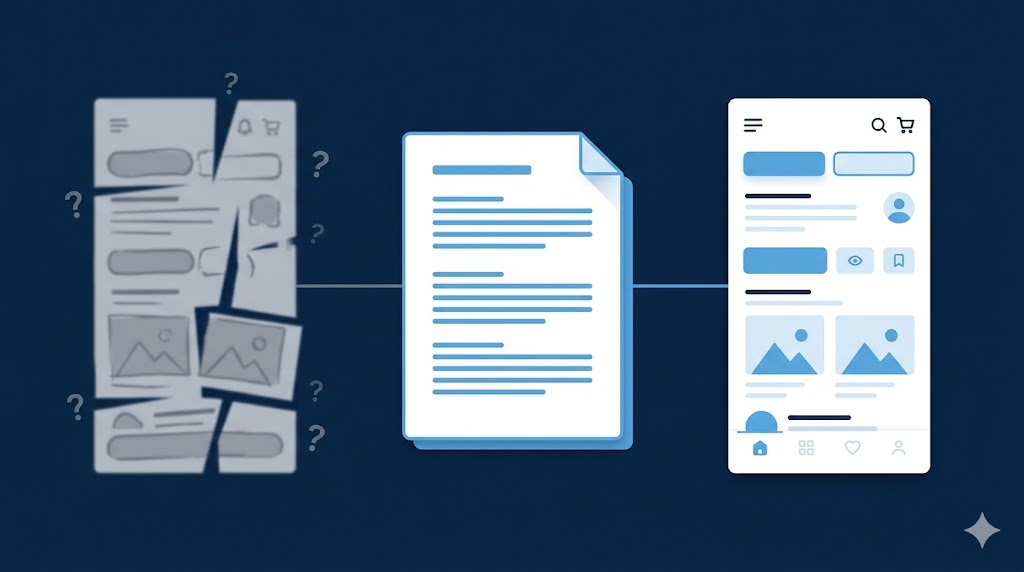
A team we work with recently asked their AI agent to implement a user registration screen. The ticket said: “Build the registration page with validation.” The agent produced something. It compiled. It ran. It was wrong — missing fields, inventing validation rules, guessing at layout. The specification was a sentence. The output matched.
The teams seeing real velocity from AI-assisted development aren’t using better models or more sophisticated tooling. Instead they’re applying a best practice that has existed for decades, writing better specifications. In practice, AI output quality is determined almost entirely by the quality of the specification the agent receives.
The Test You Can Run Today
Here’s a heuristic that works in any room, regardless of technical fluency: if you can’t hand a task to a junior developer and get a correct result on the first attempt, you can’t hand it to an AI agent and expect high-quality results.
AI delegation requires the same specification clarity as junior developer mentorship — explicit intent, clear success criteria, bounded scope, and enough context for the executor to make the right decisions without reading your mind. A lead developer on a manufacturing software team we work with independently described the pattern as “treating AI like a junior developer who needs the full blueprint.” No one prompted them. They arrived at it because it’s the operational truth.
The Junior Dev Heuristic is a highly accessible governance test. Non-technical leadership can apply it. Product managers can apply it. If the specification fails the test, the AI is likely to fail the task on the first pass.
Why Your Tickets Are the Wrong Context Surface
Many teams that adopt AI-assisted development intuitively start by connecting the agent to their existing project management tool. Tickets describe work, and AI needs work descriptions, therefore the ticket is the specification.
The problem is that tickets were never designed to carry specifications. They were designed to carry task-scoped coordination signals — assignments, statuses, and brief descriptions sufficient for human conversation to fill in the gaps. A developer who receives a vague ticket can walk over to a product manager’s desk or open a Slack thread. An AI agent that receives a vague ticket executes competently against an ambiguous instruction and produces precisely scoped nonsense.
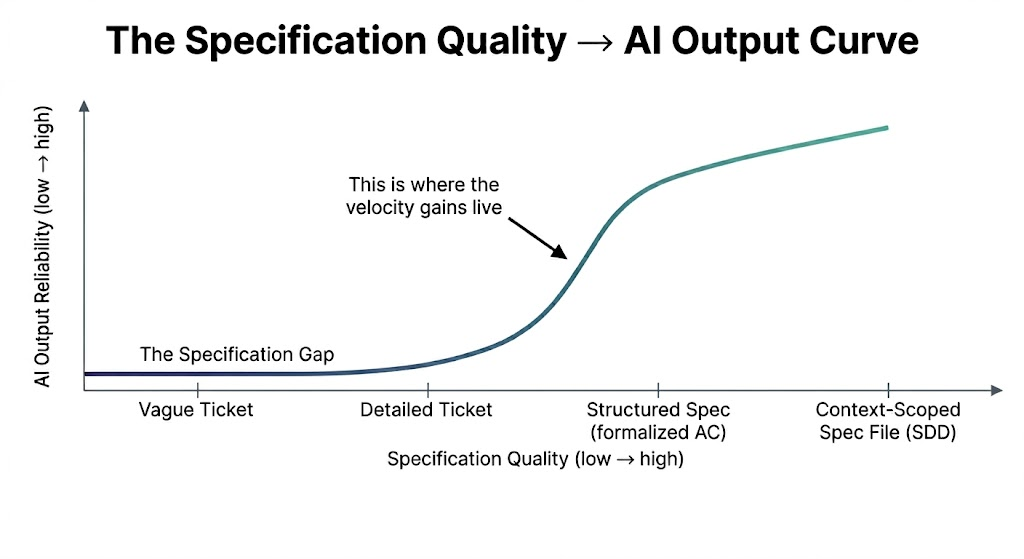
This is the specification gap: the distance between what a ticket contains and what an AI agent needs to produce a correct result. Human teams bridge that gap through conversation. AI makes the gap visible and costly, because the agent has no hallway to walk down.
Consequently, teams that simply shift to AI-assisted workflows without addressing the specification gap see the same ambiguity failures they’ve always had — now at machine speed.
A Baseline Specification Stack
Spec-Driven Development addresses the gap directly. The discipline is straightforward: write the specification before the AI executes, and make the specification rich enough to be machine-executable.
In a recent engagement, a team formalized their approach by structuring acceptance criteria using a variant of the well-established SMART tasks framework. The acceptance criteria became machine-readable: specific measurable conditions that defined “done” without requiring the AI to interpret intent. When acceptance criteria are structured this way, the agent has a precise target and, consequently, the re-interpretation loop is minimized.
But the specification unit matters as much as the specification quality. One team discovered that a markdown file scoped to a single UI screen — describing fields, validation rules, behavior, and layout — gave their AI agent a coherent, bounded context that outperformed ticket-sized thinking. The underlying principles are well-established: bounded contexts, single-responsibility specs, cohesive units of work. The screen-per-file approach is one implementation of right-sized specification for their context.
The result was concrete: one week of development work compressed into one day. The developer didn’t get a better AI tool. They got a better context unit.
From Supervision to Governance
The velocity gains from specification clarity create a new bottleneck: human confirmation. If a team writes clean specifications and the AI executes against them reliably, the remaining constraint is the human review cycle on every task.
Teams we’ve observed have addressed this by replacing per-task human confirmation with embedded rule files, e.g. CLAUDE.md, .cursorrules, or equivalent governance artifacts that encode judgment once rather than requiring re-application on every task. The governance remains human. The supervision becomes asynchronous. That’s the throughput unlock.
This distinction matters: teams that confuse supervision with governance will never break through the throughput ceiling created by per-task confirmation. Supervision asks “did you do this correctly?” after every action. Governance asks “here are the standards — apply them” before any action begins. The first scales linearly with task volume. The second scales independently.
The Specification Quality Curve
The progression is repeatable:
- Diagnose the specification gap:
Apply the Junior Dev Heuristic to your current workflows. - Restructure context:
Move from ticket-scoped coordination to specification-scoped execution artifacts. Find the right context unit for your domain. - Formalize acceptance criteria:
Structure them so the definition of “done” is machine-readable, not implied. - Encode governance:
Embed standards in rule files that the agent applies without per-task human confirmation.
Each step compounds. Better specifications produce better AI output. Better AI output builds trust. Trust enables asynchronous governance. Asynchronous governance unlocks throughput. The specification is just the first domino.
If your team has adopted AI-assisted development and the velocity gains haven’t materialized, the specification is the first place to look — not the tooling. Start with the Junior Dev Heuristic: pick three tickets from your current sprint and ask whether a competent junior developer could execute them on the first attempt with no additional conversation. The gap between what the ticket says and what the developer would need to ask reveals exactly what your AI agent is guessing at.
If you’d like a second set of eyes on where the specification gap is costing your team velocity, that’s a conversation we’re always happy to have.