

We began this journey by exploring how our use of AI is not going to replace the software development process, but rather, it highlights the necessity for that process to be disciplined. That discipline, we argued, is rooted in the fact that all outputs of our work, be they requirements, designs, or code, are ultimately forms of documentation that capture the valuable information needed to define the software being built.
However, evolving software development processes have caused teams to view documentation that isn’t “code” as less valuable when compared to direct cross-functional teams delivering working software. While this is great for team-building, it’s not ideal for product building. Consider the last time there was a difference of opinion with the Product Owner at your last product demonstration. Did you navigate back to a Jira ticket only to find it missing a description or containing no sense of acceptance criteria? Did you try to find some insight into the original problem that was trying to be solved only to find a lot of hands waving around?
We capture less information today, and when we do, we often capture that information in artifacts that are siloed off from others that depend on it, or teams produce them in a static form leading them to be almost immediately out-of-date. We create “documentation debt” that can lead to redundancy and miscommunication across our teams. The result? Misaligned products delivered slowly and a lot of hands waving around.
But let’s not be misled. The value is in the information, not the artifacts. The challenge is the inefficiency of managing the artifacts that contain the information. The solution is rooted in managing the ever-growing, interconnected body of knowledge that defines the product as it exists today.
If solving “documentation debt” isn’t attractive enough for you, consider this straightforward request. “Let’s review all of the user feedback, support requests, UX design files, and code related to the ‘new user onboarding flow’.” In today’s artifact-centric world, fulfilling this request would be very difficult and costly, and some might see it as impossible.
In this culminating article, we will propose a new paradigm that makes it possible to solve documentation debt and fulfill such requests – a shift from an artifact-centric model to an information-centric model. We will introduce the concept of a “canonical information model” that leverages AI to transform disconnected artifacts into a cohesive, living body of the essential information needed to define a product and be the single source of truth. Along the way, we’ll help those that still need an artifact by providing derived views of the information model in their favorite format.
This model represents the next evolution of product development, fully realizing the potential of an AI-augmented paradigm. That sounds pretty lofty, so before we get to the good stuff, let’s recognize some key moments in our history that this idea builds on.
The Precedent
Making a Source of Truth
The concept of a canonical information model in software development is not a new idea, but rather a modern synthesis of powerful concepts, introduced over many decades. These concepts have shifted the focus from code to a more abstract, business-centric understanding in an effort to reduce the gap between business intent and technical implementation.
While certainly not an exhaustive list, the following waypoints provide a throughline for the purposes of our focus here. The unifying theme throughout this evolution is the ongoing struggle to make the single source of truth both human-readable and machine-executable.
Executable Specifications
One of the earliest documented references to this foundational idea was published in an article titled “Rapid Prototyping in the OBJ Executable” by Josef Goguen and José Meseguer. It posited that a specification could be written in a way that a machine could interpret and execute, bridging the gap between human intent and a technical artifact, allowing for early validation of the system before the final implementation was complete.
Test-Driven Development (TDD)
Kent Beck’s self-proclaimed “rediscovery” of TDD took the idea of executable specifications and made it a core development practice. The test became the living, single source of truth for a specific piece of behavior, driving the code’s creation and ensuring its correctness.
Domain-Driven Design (DDD)
Eric Evans published “Domain-Driven Design: Tackling Complexity in the Heart of Software” and established DDD as a strategic approach to center software design and development around the business domain rather than the technology. A key concept that Evans emphasized was that of a Ubiquitous Language shared by both business and technical experts. While not an executable specification in itself, the core model of the business becomes a conceptual single source of truth, and this truth is what the code is meant to express.
Behavior-Driven Development (BDD)
Dan North introduced BDD as a refinement to TDD to address the “confusion and misunderstandings” that agile teams faced when trying to apply TDD. BDD expanded on TDD by making the executable specification understandable to a non-technical audience. The “Given-When-Then” syntax allowed business stakeholders to read and validate the specifications, making the single source of truth a shared, collaborative artifact.
Spec-Driven Development (SDD)
This is the modern culmination of these ideas and others that were born out of the height of Agile’s popularity (e.g. Fit: Framework for Integrated Test, Specification by Example). SDD asserts that a comprehensive specification, often a combination of a formal API definition and behavioral descriptions, is the ultimate single source of truth. All other artifacts (code, documentation, tests) are derived from it.
The AI-Driven Revolution
While the foundational ideas existed for decades, the key problem that remained was that a developer still had to manually translate the spec into code. This changed dramatically with the rise of large language models (LLMs) and generative AI in the last few years.
To overcome the frustration with the output of “vibe coding”, SDD found its inflection point with the realization that LLMs could act as the missing link for generating code from a structured specification. With a comprehensive “blueprint”, the LLM no longer had to guess what code to create based on vague prompts.
This new capability spurred the development of frameworks like Spec-Kit and BMAD that formalize the process of using AI to build software from a specification. They provide the structure, guardrails, and commands needed to support the transformation of an abstract idea into a tangible product.
Now, instead of a developer manually and tediously translating a huge, static document into code, an AI now acts as the “compiler” for the specification. This makes the specification a living, “executable” document rather than a historical artifact, bringing the rigor of the old methods into the flexible, iterative world of modern software development.
Naturally, LLMs and SDD frameworks represent a significant shift in how we think about the role of developers in an AI-powered world. We’ll touch on that more later.
Canonical Models
While canonical forms have a deep history in Mathematics, canonical models in software development are probably most thought of in relation to the pattern in Enterprise Application Integration and its use in Service Oriented Architectures.
One interesting application of this concept, specifically a canonical data model, can be found in a whitepaper published by CGI. This whitepaper is a valuable reference for our discussion because it provides a foundational validation of the core concept while also serving as a perfect counterpoint to highlight the innovative aspects of the approach proposed here.
The Payoff: The Canonical Information Model
The New Single Source of Truth
The root cause of our documentation debt is a conceptual failure: we have treated requirements, design, code, and test cases as disconnected artifacts that merely document reality. They are siloed in different tools, governed by incompatible formats, and degrade the moment a change occurs in a system.
The Canonical Information Model (CIM) is the definitive answer to this systemic fragmentation. It is not another place to store documents, but a fundamentally new architectural layer—a single, unified Knowledge Graph—that treats all project outputs as living, traceable data and becomes our missing single source of truth.
In the CIM, every piece of essential knowledge, from a high-level strategic business objective to a low-level API function signature, is a precisely defined node. The relationship between these pieces (e.g. the fact that a User Story node is implemented by a Code Component node, which in turn is validated by a Test Case node) becomes a formalized edge. This structure transforms the messy reality of software development into a coherent, semantically rich, and continuously verifiable data set.
Ultimately, the CIM functions as the enterprise’s Context Engine. It doesn’t just store data; it stores relationship and meaning. This explicit, verifiable structure is what enables the AI’s essential role in synthesis. The AI can synthesize raw research into justification, synthesize a design constraint into compliant code, and synthesize the validated solution into a perfect user manual, guaranteeing that all downstream deliverables are perfectly aligned with the original, validated intent.
This canonical layer isn’t only an internal-hygiene win — it’s becoming the competitive constraint in AI-augmented delivery. We make that case in Canonical Substrate Is the New Deployment.
Essential Information
The true power of the CIM is not simply its existence, but its enforcement of quality. A system that ingests all text from every Jira comment, Slack thread, and design annotation would quickly become a Garbage Graph, paralyzing rather than augmenting the team. To prevent this, the CIM is built on a process that rigorously separates the valuable signal (essential information) from the noise (the artifact container).
Criteria for Essential Information
An item is deemed essential information only if it can be extracted from its source and successfully normalized into the CIM’s rigid Canonical Ontology. This process is governed by two key criteria:
- Semantic Value: The information must capture a quantifiable fact, decision, or requirement that is critical for defining the software. For example, a Jira comment stating “The client prefers blue over green for the button” is essential. A comment stating “Did you get my email about the button?” is not.
- Verifiable Traceability: The information, once extracted, must be capable of forming a valid relationship (an edge) with at least one other node in the graph. If a fact cannot be linked to a User Persona, a Business Objective, or a Code Component, the system tags it as unstructured noise, which can be archived but will not be elevated to the level of canonical truth.
The Three-Step Enforcement Process
This quality control is performed by the AI agents and creates a high-friction barrier to entry for low-quality data, ensuring the CIM remains clean and actionable.
Step 1: Extraction
- Goal: Distill the Signal
- Description: The AI agent uses adapted techniques (including NLP, API-based parsing, and Computer Vision) to read a raw artifact and identify the explicit facts, relationships, and decisions that meet the Semantic Value criteria.
Step 2: Normalization
- Goal: Fit to Schema
- Description: The extracted facts are converted from their source format into structured data. They are forced to conform to the CIM’s predefined Canonical Ontology, becoming a formally named Node (e.g., Authentication Requirement) with defined Attributes and Edges (e.g., Security_Level: High).
Step 3: Validation
- Goal: Enforce Consistency
- Description: The system tests the new information against existing truth and rejects the ingestion if a conflict occurs (e.g., a new component violates a global design token).
Mastery of Specification
The greatest payoff of the Canonical Information Model (CIM) is the re-skilling of the enterprise. When the AI agents assume responsibility for the mechanical, error-prone work of implementation (scaffolding code, updating tickets, syncing documentation), the human professional is liberated to focus on the work that requires human ingenuity: defining, refining, and validating the precise specifications that govern the solution.
The CIM fundamentally shifts the job of every contributor, turning them all into a Master of Specification within their domain of expertise and within the toolset that helps them accomplish this best. This creates a state of Canonical Alignment where every part of the business speaks the same language of truth.
Mastery of Objective: Product and Strategy
The Product Owner’s and Manager’s superpower shifts from writing voluminous requirements documents to mastering the Specification of Objective.
- The Problem: In the old paradigm, moving from a requirements document to a project-tracking ticket was often just replacing one large, static artifact with another. Both were descriptive records whose value depended entirely on manual human interpretation.
- The Shift: The Product Owner provides the why and the what by creating clean, unambiguous specifications of Business Objectives, Feature Descriptions, and User Stories directly through their existing product management tools. Crucially, the AI agents validate, normalize, and transform the essential information into intelligently connected Nodes in the CIM.
- The Value: The immediate value is strategic insight and enforcement. For example, the system can immediately notify the Product Owner if a newly entered User Story node violates a Constraint (e.g., “This feature violates the GDPR_Data_Policy constraint”). The Product Owner could also use the CIM as a semantic query engine, running sophisticated strategic queries like, “Show me all active User Stories that are not linked to a current Business Objective, but which are linked to unfulfilled Customer Feedback.” This empowers the Product Owner to instantly identify strategic gaps and prevent wasted development effort.
The Product Owner’s job is elevated from being a document custodian to being an active strategist, validating the meaning and purpose of work against the enterprise’s goals and measuring outcomes against those goals, all using the power of the CIM.
Mastery of Experience: Design and UX
The Designer’s role evolves from delivering a static visual file (the artifact) to mastering the Specification of Experience – an executable definition of the user interface.
- The Problem: The old paradigm relies on interpretation drift. The designer delivers a design file (Figma/Sketch), and the developer manually translates it into code. The designer then spends time on redundant design reviews, manual specification documentation, and chasing down developers for small discrepancies in spacing or color usage. The fidelity of the final product hinges on manual human attention.
- The Shift: The Designer provides the look and the feel by defining structured Design Tokens and Component State specifications within their existing design tool. Additionally, the Designer can map User Flows, define Interaction specifications, and incorporate Accessibility and Usability requirements. Crucially, the AI agents perform an Extraction process that validates and transforms the design’s essential information (e.g., Button Component, PrimaryColor Token). This structured input is directly linked as Constraints on the implementation.
- The Value: The immediate value is guaranteed fidelity and freed time.
- Enforcement: The designer’s specification is now a formal constraint. Any AI-generated or human-written code that attempts to violate a core Design Token (e.g., using an unauthorized font or spacing value) or a core Accessibility Constraint (e.g., a color contrast ratio violation) is instantly flagged and rejected by the Validation agent, guaranteeing 100% design-to-code fidelity without manual code review.
- Strategic Insight: The designer gains strategic power by using the CIM’s semantic query engine to perform system health checks: “Show me all Component nodes that are still using an unapproved color token and are linked to an active User Story node.” This allows the designer to focus their energy on refining the design system where it creates the greatest impact, rather than policing implementation.
The Designer’s job is elevated from being a meticulous design reviewer to being an enforcer of brand and user experience, ensuring that the entire codebase is automatically compliant with their final, approved vision, all using the power of the CIM.
Mastery of Constraint: Architecture and Compliance
This mastery establishes the system’s structural and legal firewall. The Architect, Security Specialist, and Compliance Officer shift from writing static policy documents to mastering the Specification of Constraint—formally coding the non-negotiable boundaries of the system into the CIM.
- The Problem: In the old paradigm, constraints and regulations (e.g., “All personal data must be encrypted,” “We use a microservices architecture”) live in documents separate from the design and code. Enforcement relies on manual, expensive audits and code reviews, often finding violations only after the code is written, leading to costly rework and risk exposure.
- The Shift: The Architect and Compliance Officer provides the rules and boundaries by defining structured Constraints using structured interfaces built atop their preferred documentation tools or ADR platforms. Crucially, the AI agents immediately ingest these formal rules as active veto power within the CIM. The specification includes:
- Architectural Constraints (e.g., “Only authenticated services may access the database layer”).
- Regulatory Constraints (e.g., GDPR mandates specific data deletion protocols).
- Security Constraints (e.g. “All data classified as PII_EU_Resident must be processed only by Service_Node implementations that have a verified Encryption_Protocol: AES-256 edge and are deployed exclusively to Data_Center_Location: EU.”)
- The Value: The immediate value is zero-tolerance enforcement and automated risk mitigation.
- Enforcement: The Validation AI Agents use these Constraint Nodes as a universal rulebook. Any proposed design, user story, or generated code that would violate a standing constraint is instantly flagged and rejected before implementation begins. This shifts compliance checking from a post-facto audit to pre-emptive, automated governance.
- Strategic Insight: The Master of Constraint can use the CIM’s semantic query engine to perform automated risk analysis. For example: “Show me all Component nodes in production that handle User_Data and are NOT linked to a valid Encryption_Protocol constraint node.” This allows them to proactively identify systemic gaps and risk exposure without manual documentation cross-referencing.
The Architect’s and Compliance Officer’s jobs are elevated from being document custodians and auditors to being active system guardians, enforcing structural integrity and legal safety at the specification level, all using the power of the CIM.
Mastery of Validation: Testing and Quality Assurance
The Tester’s job evolves from finding defects in code to mastering the Specification of Validation—formally challenging the system’s core assumptions and defining what a correct solution looks like from the user’s perspective.
- The Problem: The old paradigm relies on code-level testing to find implementation defects. Testers spend their energy validating the implementation instead of validating the specification. The costliest defects, however, are rooted in fundamental flaws in the Objectives or Constraints—the equivalent of “Garbage In, Garbage Out”.
- The Shift: The Tester delegates all mechanical validation (unit, integration, and compliance checks) to AI agents. The AI generates these tests automatically from the Implementation Specification and Constraints. The human Tester’s focus shifts entirely to strategic, human-centric validation that requires judgment. Their work is to formally define high-level acceptance criteria and then perform semantic gap analysis to challenge the upstream specifications.
- The Value: The immediate value is zero-defect specifications and root-cause quality assurance.
- Strategic Focus: The Tester is entirely freed to focus on exploratory, usability, and end-to-end behavioral testing that requires human ingenuity, as well as vulnerability hunting (e.g., penetration testing) that challenges the formal Security Constraints. This is where they find specification defects—the misalignment between the system’s technical output and the user’s actual needs.
- Enforcement Loop: When a defect is found via exploratory testing, it must result in an update to an upstream specification (Objective, Experience, or Constraint), not just a simple code fix. This forces the Product Owner, Designer, or Architect to re-validate their initial premise, shifting the cost of fixing defects back to the source of the problem.
- The Challenge Agent: The Tester uses the CIM as a semantic query engine to proactively challenge the system’s integrity: “Show me all paths from the Objective Node to the Implementation Node that are not covered by an Exploratory Test Case or a Security Constraint.” This gap analysis finds specification debt, identifying critical areas that were overlooked or implicitly assumed during the definition phase, compelling the team to formalize the intent.
The Tester’s job is elevated from being a bug finder to being an enforcer of quality and strategic integrity, ensuring the entire system meets its intended purpose and forcing human accountability for the CIM’s foundational assumptions.
Mastery of Implementation: The Engineer
The developer’s expertise is redirected toward solving novel, complex logic problems that require human ingenuity. They shift from writing low-value boilerplate to mastering the Specification of Implementation—defining the complex “how” that remains outside the AI’s autonomous capabilities.
- The Problem: The old paradigm forces engineers to spend the majority of their time on plumbing and scaffolding (boilerplate, data persistence, setting up environments), delaying their ability to focus on critical non-functional requirements.
- The Shift: The Engineer focuses their effort on the final, most critical layer: the novel logic and non-functional requirements (performance, concurrency, resilience) that demand human intelligence. The AI agents assume responsibility for the mechanical implementation. The engineer’s primary input is the creation of precise links and meta-data within their IDE or Version Control System (VCS). These inputs establish the edges that:
- Link the new code back to the Objective Node (Traceability).
- Prove adherence to the Design Token (Experience).
- Confirm compliance with the Security Constraint (Constraint).
- The Value: The immediate value is radical efficiency and guaranteed alignment.
- Strategic Focus: The engineer avoids the 80% of routine coding tasks, focusing solely on the 20% of complex logic that delivers core business value.
- System Integrity: Their final act is to close the loop by linking the generated code to the validated specifications, thereby completing the enterprise’s Intent Integrity Chain. If a bug is later found in a piece of code, the engineer can use the CIM’s semantic query engine to instantly determine: “Which User Stories and Business Objectives are impacted by this code, and which Architectural Constraint did it violate?” This transforms debugging from a forensic investigation into a precise data query.
The Engineer’s job is elevated from being a code producer to being the final arbiter of logic and system integrity, ensuring the entire solution is structurally sound and aligned with all upstream specifications, all using the power of the CIM.
Mastery of Communication: Technical Writing and Documentation
The Technical Writer’s role is elevated from manually synthesizing information to mastering the Specification of Communication—defining how the CIM’s truth is translated and delivered to every audience.
- The Problem: In the old paradigm, technical writers are bottlenecks. They must manually audit code or interview developers to confirm feature behavior, leading to documentation that is often outdated and inconsistent in tone across different deliverables (e.g., in-app help vs. user manual).
- The Shift: The Technical Writer delegates all information gathering to the AI, which automatically generates Release Notes, User Manuals, and Help Content directly from the validated Objectives, Experiences, and Implementations. Their human focus shifts to defining the Communication Constraints.
- The Value: The immediate value is guaranteed tone and structure, eliminating documentation debt.
- Enforcement: The writer inputs Style and Tone Constraints (e.g., “All user-facing documentation must use a supportive, non-technical tone,” or “All API documentation must follow the Google style guide”). The AI agents use these constraints to govern the generation and language of every deliverable.
- Strategic Focus: The writer focuses on curating and translating the CIM’s truth, ensuring the language and structure are perfectly segmented for the audience (e.g., differentiating marketing copy from installation instructions).
The Technical Writer’s job is elevated from being a documentation synthesizer to being an enforcer of brand voice and clarity, ensuring every message drawn from the CIM is perfectly tailored to its audience.
Derived Views of the Source of Truth
The greatest architectural challenge of the Canonical Information Model (CIM) is also its strength: it represents the entire software project as a complex, interconnected Knowledge Graph. While this structure is ideal for AI agents, it is impractical for human workflows.
The CIM is a data model, not a user interface. To bridge this gap, the system exposes all canonical information through specialized, live Views tailored to specific roles and deliverables. All traditional static artifacts and deliverables are replaced by these Views, which function as live queries against the single CIM, guaranteed to be accurate because they pull their information dynamically from the canonical nodes and edges.
- User Manuals/Product Help
- Help content is generated and updated automatically the moment a feature is validated. Its tone and structure are governed by the writer’s Communication Constraint Nodes, eliminating documentation debt.
- CIM Query: Feature Description nodes, Acceptance Criteria edges, and Design Token names.
- Release Notes
- Release Notes are generated instantly and are perfectly accurate, eliminating the need for a developer or PM to manually compile a list of changes.
- CIM Query: User Story nodes linked to a specific Deployment Status node (e.g., “Deployed to Production”).
- Product Roadmap
- The live roadmap is a single source of truth for strategy, with the status of any feature being provably accurate, fostering trust with stakeholders.
- CIM Query: Business Objective nodes linked to high-level Feature nodes and their aggregated Progress Status edges.
- Vulnerability Audit Report
- A Compliance Officer can generate a full audit report in seconds, proving adherence to complex regulations with provable traceability for every line of code.
- CIM Query: All Code Commit nodes linked to specific Regulatory Constraint nodes (e.g., GDPR, SOC 2).
- Semantic Impact Analysis
- Any user can ask a natural language question (e.g., “What is the impact of removing the ‘Primary Button’ token?”) and the system returns a verifiable list of every dependent file, feature, and test case across the entire graph.
- CIM Query: Queries the Vector Database for semantic meaning, linked to the Graph Database for traceability.
The Product Discovery – Product Delivery Bridge
We have focused heavily on Product Delivery—the process of turning specifications into deployable software. However, the continuous engine that drives the entire enterprise is Product Discovery—the continuous process of learning, interviewing, and experimentation that generates the Objectives and Features necessary to delight customers.
The Canonical Information Model (CIM) must be a two-way system: supporting disciplined Delivery while being continuously fueled by high-quality Discovery.
Specification Quality: The Inviolable Principle
The dependency on specification quality, which we have assigned to our Masters of Specification, is the CIM’s inviolable principle: Garbage In, Garbage Out (GIGO).
The CIM is a powerful automated system, but it only weaves with the thread it is given. It automates the building of an idea; it does not vet the idea itself. A flawed Objective will lead to a perfectly built, useless Feature. The role of the CIM is not to fix poor thinking, but to use its structure to facilitate the human-led validation necessary to catch flaws early.
Product Discovery: The Upstream Fuel
In the old paradigm, Product Discovery creates siloed artifacts: customer interview transcripts, market analysis decks, raw survey data, and competitive reports. These artifacts are descriptive, telling a story about a problem. They are then manually, and subjectively, translated into prescriptive delivery tickets (Objectives and User Stories), losing context and traceability in the hand-off.
The CIM as the Discovery-Delivery Bridge
The key to integrating Product Discovery lies in the CIM’s capability to ingest and structure information regardless of its format. The system’s AI processing engine automatically converts unstructured Product Discovery data (e.g., raw customer surveys and interview transcripts, business stakeholder workshop notes, market research notes, and recordings) into verifiable, semantic information.
This achieves two critical outcomes:
- Ingesting Raw Data: The CIM’s processing layer automatically extracts the semantic meaning from thousands of pages of research, creating Discovery Justification. This makes the raw voice of the customer semantically searchable by the entire organization.
- Traceability for Justification: When the Product Owner creates a new Business Objective node, they are required to link it to the relevant Discovery Justification that proves its business value. This is the first, most crucial verifiable Edge in the entire process.
The Product Owner can now use the CIM’s semantic query engine to directly challenge a new feature: “Show me the raw customer research that links to this Objective.” This instantly forces the Product Owner to validate their premise against the uninterpreted source data, effectively closing the quality assurance loop between the Delivery team and the Discovery findings without the need for manual file-hunting.
The CIM ensures that Product Discovery is no longer an isolated event that produces a static artifact, it is a continuous information input stream. Teresa Torres outlines a Continuous Product Discovery Loop as follows:
- Identify a Desired Outcome
- Discover Opportunities to Drive that Desired Outcome
- Discover Solutions that Deliver on those Opportunities
- Run Experiments to Measure Attainment of the Desired Outcome
This continuous cycle will populate the knowledge graph, ensuring that every piece of work in the Product Delivery pipeline is perpetually anchored to the customer data that justified it.
Conclusion: The Canonical Mandate
We’ve established that the future of AI-augmented software development isn’t about asking the AI to write more code; it’s about challenging humans to define better intent.
The industry is already proving this mandate in practice. As software teams integrate AI coding agents, they confront a harsh reality, as recently captured by Vishal Kapur:
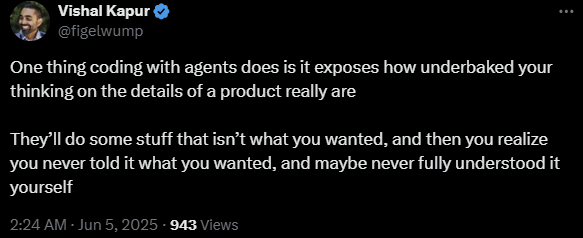
This quote is the indictment of the Artifact Paradigm. Today, we are exposed because AI agents are ruthlessly efficient at revealing our lack of canonical clarity. The problem is not the AI’s capability; it is the human’s incomplete specification.
The Canonical Information Model (CIM) represents the necessary conceptual response to this challenge. It is the structure that forces humans to articulate, formalize, and align their intent across six crucial disciplines—transforming siloed experts into verifiable Masters of Specification.
The era of documentation debt and fragmented artifacts is ending, not by technological revolution alone, but by a philosophical reckoning. The CIM represents a solid conceptual framework for managing the volume, velocity, and complexity of modern software development by treating the human mind as the ultimate source of truth.
To survive the shift to AI-augmented development, every organization must seriously consider the Canonical Mandate: The quality of your output will forever be determined by the quality of your input. Only by adopting a unified, verifiable model for intent—by moving from artifacts to information—can we finally build a stable, scalable, and trustworthy foundation for the future of software.
A Final Thought: Uncovering Better Ways
This exploration into the Canonical Information Model (CIM) began not as an abstract thought experiment, but as a direct response to a frustration I’ve witnessed and experienced countless times: the silent, systemic decay of documentation debt. Watching brilliant teams lose momentum and morale because their process treated their hardest-won knowledge as throwaway artifacts was the starting point for this journey.
The CIM is the eventual blueprint, but its true origin lies in the persistent application of the Agile Mindset. It is the outcome of treating that pervasive documentation problem as a process defect demanding deep introspection and continuous improvement. We realized that to move beyond the Artifact Paradigm, we had to stop treating symptoms and start addressing the systemic failure of information management. This work, this model, is simply the better way we ultimately uncovered.
For many teams, the key to unlocking systemic change lies in investing enough time and rigor in practices like Sprint Retrospectives, Process Tuning, and Deep Organizational Learning—the very mechanisms designed to uncover your own better ways. If this article resonates with a systemic pain point in your organization, consider it an encouragement to pause, reflect, and make that crucial investment.
If you are seeking a partner to help your teams embark on their own journey, Agile Caddie understands the value of making such investments. We would welcome a conversation to discuss how to put your teams on the path to discovering their own better ways. Let’s talk!